Grass Along Driveways and Sidewalks Usually Break Down First
Some parts of a lawn start showing stress earlier than others.
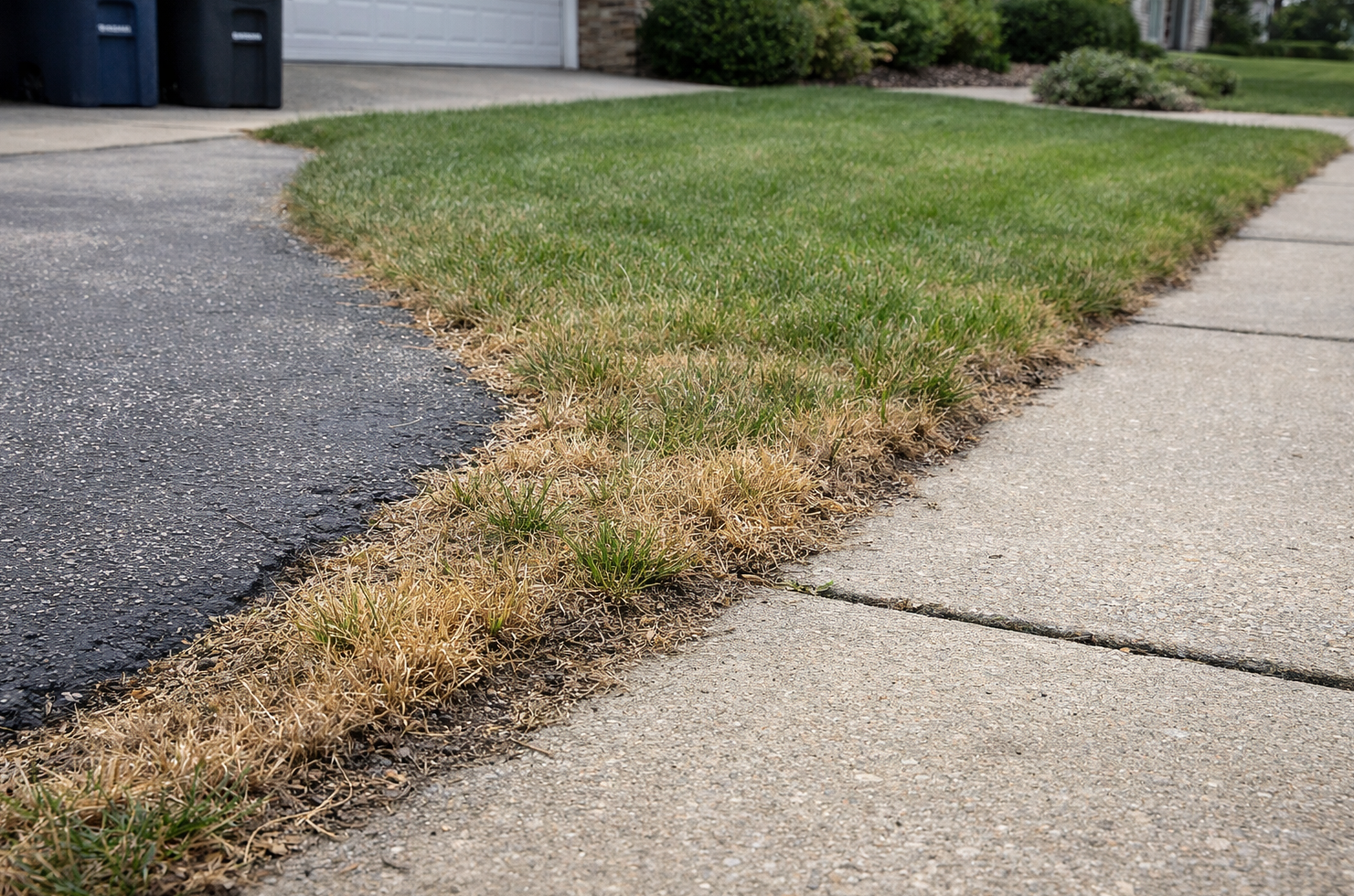
The edges along driveways and sidewalks are a common example. The grass may start thinning there first. It may lose color faster in summer. It may look weaker along the border even when the rest of the yard is still holding together reasonably well. In some cases, those edges start opening up every year and never seem to match the rest of the lawn for very long.
That pattern usually is not random.
Grass along concrete edges often deals with harder conditions than the rest of the property. Those strips may look like a small part of the lawn, but they are often exposed to more heat, drier soil, tighter growing space, and more repeated stress than open turf farther away from pavement.
That is why those areas tend to break down first.
Concrete edges create a tougher growing environment
A lawn edge next to a driveway or sidewalk does not function like the middle of the yard.
It has less buffer. It is exposed on one side to hardscape rather than surrounding soil. That means the turf is growing in a narrower zone with less room for stability. The grass may still look fine when conditions are mild, but once pressure builds, those edges often show it first.
That is because pavement changes the environment around the turf.
Concrete reflects heat. It influences moisture loss. It creates a sharper surface transition. It can also affect how water moves or runs off during rain. All of that makes the edge a more demanding place for grass to stay dense and consistent.
The lawn is not reacting to the edge visually. It is reacting to the conditions that edge creates.
Heat stress tends to build faster along pavement
One of the biggest reasons lawn edges struggle is heat.
Driveways and sidewalks absorb sunlight, warm up, and radiate that heat back toward the grass. That puts the turf along the border under more temperature stress than sections farther into the lawn. Even when the yard looks evenly exposed from a distance, the edge can be operating under harsher conditions.
That heat matters most during summer.
The grass along pavement often dries out faster, weakens sooner, and loses resilience earlier than the rest of the property. It may start to look dull, thin, or stressed while the central lawn still seems reasonably stable. Homeowners sometimes assume the edge needs more fertilizer because it looks weaker, but the issue is often environmental pressure, not simple lack of feeding.
That is why the lawn border can start slipping first even when the rest of the yard still looks acceptable.
Moisture along driveways and sidewalks is often less balanced
Water does not always behave well at the edge of concrete.
Sometimes those areas dry out faster because heat builds up and moisture leaves the soil more quickly. Other times water runs off the pavement and moves unevenly into the lawn, creating inconsistent moisture patterns along the border. The result is often a strip of turf that never gets the same steady growing conditions as the interior lawn.
That inconsistency matters.
Grass performs better when moisture stays relatively balanced. Along concrete edges, it often does not. The turf may cycle between drying down too quickly and receiving uneven runoff, depending on the shape of the site and the weather pattern. That makes it harder for the grass to stay full and stable over time.
A lawn edge can look like a simple cosmetic boundary, but from the turf’s perspective, it is often one of the least forgiving parts of the property.
Soil along the edge is often more limited and less forgiving
The grass next to concrete usually has less working room than grass in open sections of the lawn.
That limited root space affects how well the turf can tolerate stress. The edge may have shallower usable soil, tighter conditions, or a more restricted zone for root development. When the lawn is under pressure, that smaller margin shows up quickly.
This is part of why edge breakdown can feel so repetitive.
The grass may improve when conditions are favorable, then decline again once summer heat, dryness, or traffic returns. The area never had much reserve to begin with, so it reaches the point of visible stress sooner than the rest of the yard.
That does not mean the edge is unmanageable. It means it should not be evaluated the same way as the middle of the lawn.
Traffic pressure often adds to the decline
Lawn edges do not just deal with environmental stress. They often deal with more physical pressure too.
People step there when getting in and out of vehicles. They cut across sidewalk borders. Trash bins get rolled through the same path. Pets may track the edge repeatedly. Small, repeated pressure adds up, especially when the turf is already dealing with heat and moisture stress.
That is when the edge starts losing density faster.
A healthy lawn can tolerate some use, but turf that is already operating in a tougher environment has less margin for repeated wear. The result may not be dramatic all at once. More often, it looks like a slow decline. The edge gets thinner, a little rougher, a little less even, and more prone to opening up.
Because it happens gradually, homeowners often do not notice how much pressure those strips actually take until the breakdown becomes obvious.
Snow, salt, and winter accumulation can make edge decline worse
In colder climates, lawn edges also tend to absorb more winter stress.
Snow gets piled near driveways. Slush collects along sidewalks. Ice melt and salt exposure can affect the turf nearest pavement. By the time spring arrives, those areas may already be behind the rest of the yard before the growing season has even started.
That matters because the edge is not beginning the year from the same starting point.
A strip that comes out of winter weaker will usually have a harder time holding together once summer stress shows up later. That is one reason edge areas often look thin, off color, or delayed in spring, then continue falling behind through the season.
The issue may seem like a summer problem, but the breakdown often starts earlier.
Mowing patterns can make lawn edges weaker over time
Edges along driveways and sidewalks also tend to take more abuse during mowing.
Turns happen there. Wheels track there. The cut may be slightly tighter near the border. Repeated mower movement along the same narrow strip can add compaction and wear over time, especially if the soil is already dry or stressed.
This is not always the main reason the edge breaks down, but it often contributes.
The turf near concrete is already working with less room and more exposure. Add repeated mechanical pressure, and it becomes easier to understand why those sections often stop matching the rest of the lawn.
That is especially true on properties where the edge looks worn year after year despite normal seasonal service.
Weeds often move into the edge after the turf weakens
Once grass along concrete starts thinning, weeds often take advantage of the opening.
That is why driveway and sidewalk borders can become some of the most visually uneven parts of a property. The turf weakens first, then opportunistic growth moves in where density has been lost. At that point, the weeds become more noticeable than the actual cause of the problem.
But the weeds are often secondary.
The first issue was that the grass along the edge was under more pressure than it could comfortably handle. Once density dropped, the border became easier for weeds to enter. Treating the weeds matters, but the underlying stress still needs to be understood if the goal is a more stable result.
Otherwise the same pattern usually repeats.
Thin lawn edges are often a sign of reduced resilience
One of the most useful ways to look at edge breakdown is as an early warning sign.
The grass along concrete is often the first place where reduced lawn resilience becomes visible. It is the part of the property with the least cushion for mistakes, weather swings, compaction, heat, and dryness. When that area starts slipping, it often means the lawn is running with less margin than it appears.
That makes the edge important.
It is not just a rough strip to ignore. It is often the section that shows where the property is least stable. A border that repeatedly fades, thins, or opens up can tell you a lot about site pressure, soil performance, and how the lawn responds when conditions get harder.
That is why these areas deserve more attention than they usually get.
Seeding the edge does not always fix the reason it keeps failing
A lot of homeowners respond to thin lawn edges by adding seed.
Sometimes that helps for a while. But if the growing conditions along the concrete are still harsh, the new grass is entering the same difficult environment that weakened the previous turf. It may germinate, fill in briefly, and then start thinning again once stress returns.
That is why edge repair often feels temporary.
The issue was not just missing grass. The issue was that the edge was under more pressure than the surrounding lawn, and nothing changed about that pressure. New seed can only do so much if the site conditions remain the same.
That does not mean seeding is wrong. It means it works better when it is part of a broader effort to improve stability, not just patch appearance.
Fertilizer alone usually does not solve edge decline
This is another place where people often misread the problem.
Because the edge looks weaker, the assumption is sometimes that it just needs more feeding. But turf along concrete does not usually break down first because it was the hungriest part of the lawn. It usually breaks down first because it was the most exposed part of the lawn.
Nutrition still matters. A well managed program supports density and overall strength. But fertilizer alone does not remove heat reflection, increase root space, reduce traffic, or fix moisture imbalance. If the edge is under structural pressure, feeding by itself will not fully solve that.
The area needs to be understood in context.
A recurring edge problem usually points to a recurring site condition
If the grass along the driveway or sidewalk breaks down every year, that pattern should be taken seriously.
It usually means the edge is dealing with the same stress cycle over and over. Summer heat builds. Moisture becomes uneven. The border thins. Weeds exploit the opening. The strip gets patched or treated, then the process repeats the next season.
That is not just bad luck.
It is usually a sign that the site conditions along that boundary keep putting the turf at a disadvantage. Until that is recognized, the lawn edge will often continue acting like the weakest part of the property.
What helps lawn edges hold together better over time
The best response depends on the property.
Some edges need better seasonal support so the turf goes into stress periods stronger. Some benefit from corrective work where compaction, thinning, or recurring weakness has reduced density too far. Some simply need to be understood as higher pressure zones that require more realistic expectations and more deliberate management.
What usually does not work is pretending the border should perform exactly like the middle of the yard.
It rarely operates under the same conditions. The goal should be to reduce the reasons that area keeps falling behind and support it as one of the more vulnerable sections of the lawn.
That is how edge improvement becomes more durable instead of cosmetic.
Why this issue stands out so clearly in the Greater Rochester area
In Western NY, lawn edges can become especially noticeable because the turf is already moving through a wide range of seasonal conditions.
Winter accumulation, spring runoff, summer heat, and repeated moisture swings can all hit pavement borders harder than open lawn. Add traffic and compaction, and the edge often becomes one of the first areas to show stress in a visible way.
That is why these strips matter more than they seem to.
They are often where the property reveals imbalance first.
What grass breaking down along concrete is usually telling you
When grass along driveways and sidewalks starts thinning before the rest of the lawn, the issue is usually bigger than appearance.
It is often a sign that the edge is dealing with harsher conditions, less resilience, and more repeated pressure than the rest of the yard. Heat, moisture loss, restricted root space, traffic, and seasonal stress all tend to collect there.
That is why those areas break down first.
The edge is not just weaker by chance. It is functioning in a harder environment. Once that is understood, the lawn can be managed with a clearer view of what that part of the property actually needs.
LawnLogic FAQ
Why does grass next to my driveway die faster than the rest of the lawn?
It often faces more heat, drier soil, and more physical pressure than the rest of the yard. Those conditions make the turf along the driveway less resilient during stress periods.
Is grass along sidewalks harder to keep healthy?
Yes, in many cases. Sidewalk edges often deal with reflected heat, uneven moisture, restricted growing space, and repeated traffic, all of which make stable turf harder to maintain.
Will overseeding fix thin grass along concrete edges?
It can help, but it may not last if the edge is still dealing with the same underlying pressures. Seeding works best when the broader site stress is also taken into account.
Are weeds along driveways a separate issue?
Usually not. They often show up after the turf has already thinned. Once density drops along the edge, weeds have more room to move in.
Improve the areas that start slipping first
If the grass along your driveway or sidewalk keeps breaking down, the pattern usually points to more than a surface issue. LawnLogic evaluates how different parts of the property are functioning so weak lawn edges can be managed more deliberately, supported more effectively, and kept more stable through the season.
Explore More About Managing Your Lawn
Continue building your understanding of how structured lawn care supports long-term stability.