Thin Turf Around Trees Usually Points to a Bigger Imbalance
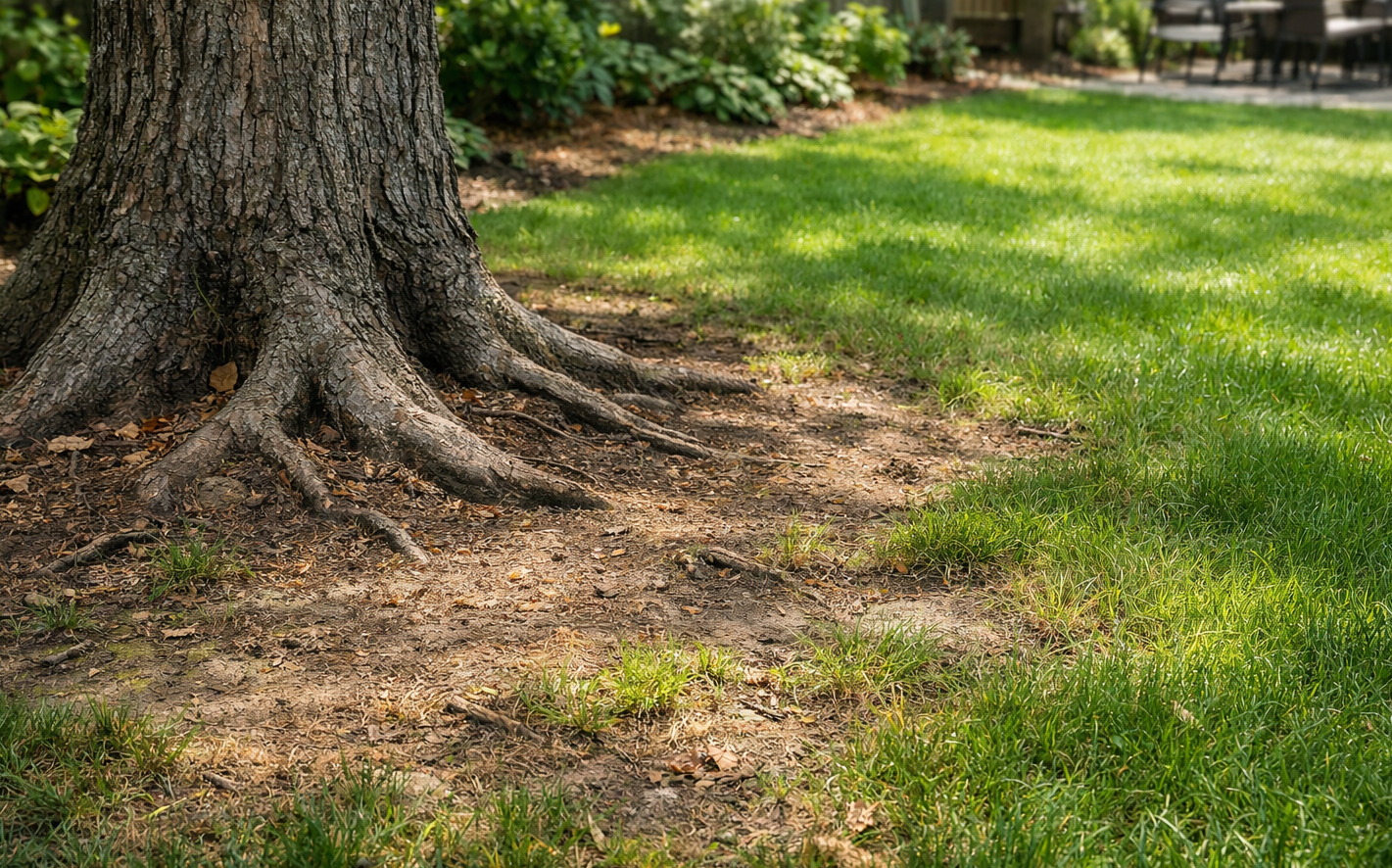
Thin grass around trees is one of the most common patterns homeowners notice in a lawn.
The grass starts thinning near the base of the tree, around the root zone, or across the surrounding area while the rest of the yard stays fuller. Sometimes it looks like the turf just never catches up there. Other times it starts as light thinning, then gradually turns into a weak ring, patchy cover, or a section that keeps opening back up no matter how many times it is seeded.
A lot of people treat that as a simple grass problem.
It usually is not.
Thin turf around trees often points to a broader imbalance in how that part of the property is functioning. The grass is not just competing with one isolated issue. It is often dealing with less light, more root competition, inconsistent moisture, tighter soil, and a growing environment that is fundamentally different from the rest of the lawn.
That is why these areas tend to stay weak even when the rest of the property looks reasonably stable.
Tree areas rarely function like the rest of the lawn
One of the biggest mistakes homeowners make is assuming the grass around trees should behave like every other section of the yard.
It usually will not.
A tree changes the conditions around it in multiple ways at the same time. It creates shade. It pulls water. It competes for nutrients.
It changes airflow. It influences how quickly the ground dries or stays damp. As the tree matures, those effects become more noticeable. The lawn underneath or around it starts living in a more restrictive environment than the open sections of turf elsewhere on the property.
That difference matters.
When thin turf develops around trees, it is often the lawn showing that the site conditions in that area no longer support the same level of performance as the rest of the yard.
Shade is part of the issue, but rarely the whole issue
Most homeowners immediately blame shade when grass gets thin around trees.
Shade is definitely part of the conversation, but it is rarely the only reason.
Reduced sunlight limits how much energy the grass can produce and slows overall growth. Areas with heavier canopy cover often stay thinner because the turf simply cannot perform at the same level with fewer usable light hours. That alone can weaken density and make recovery slower.
But plenty of tree areas stay thin even when the shade does not seem severe.
That is because the grass is usually dealing with more than just lower light. It is also competing with the tree itself. The tree is using water and nutrients from the same soil space, while the lawn is left trying to function with fewer available resources. So while shade may be the most visible factor, it often sits inside a larger site imbalance.
Root competition creates constant pressure below the surface
This is one of the biggest reasons turf around trees struggles.
The grass and the tree are not using separate systems. They are drawing from the same general soil environment. As tree roots expand, they compete with the turf for water and nutrients. In many cases, the tree has the advantage.
That pressure does not always create immediate damage. More often, it creates chronic weakness.
The lawn may still grow there, but it stays thinner. It may green up, but not as evenly. It may respond after seeding, then fade again once summer pressure builds. It may never look completely bare, but it also never seems to get fully established.
That pattern usually means the turf is not operating with enough support to stay strong in that location.
Moisture around trees is often less balanced than it appears
Homeowners often assume the grass around trees should be fine because it gets the same rain or irrigation as the rest of the lawn.
That is not always how it works.
A tree canopy can intercept rainfall before it ever reaches the ground. At the same time, the tree itself is pulling moisture from the soil. That means the lawn around the tree may dry out faster or receive less usable water than nearby open turf, even when the whole yard seems to be getting watered evenly.
In other cases, the opposite can happen. Dense shade and reduced airflow can cause certain areas to stay damp longer, especially if the site already has drainage limitations.
That uneven moisture behavior is one more reason these areas stay unstable. The grass is often not getting the kind of balance it needs to stay full and consistent.
Soil around trees often becomes harder for turf to succeed in
Tree areas often become more difficult for grass over time, even if nothing dramatic changes above ground.
As roots expand and surface conditions tighten, the soil can become less favorable for turf establishment and recovery. Organic debris builds up. Surface roots may begin to influence grade and soil depth. The lawn may start dealing with tighter conditions, less workable space, and a more restricted root zone of its own.
That makes it harder for the turf to thicken, recover from stress, or hold up through seasonal pressure.
If the area also sees foot traffic, mower turning, or repeated use around the tree, the problem usually compounds. What starts as a slightly weak area gradually becomes a recurring trouble spot because the lawn never gets back to a strong baseline.
Repeated thinning around trees is usually a pattern, not a coincidence
When turf keeps thinning around the same trees year after year, that is not random.
It usually means the site conditions in that area are consistently working against the lawn. The grass may improve temporarily during strong growing periods, then thin again once the environment becomes more demanding. That cycle often leads homeowners to keep trying the same surface level fix over and over.
More seed gets applied. A little fertilizer gets added. The area improves for a short time, then falls back again.
That does not mean those efforts were pointless. It means they were not enough to change the underlying conditions that keep making the area weak.
The problem is recurring because the imbalance is recurring.
Thin grass around trees is not always solved by adding more seed
Seeding has a place, but it is often overused as the default answer.
If the conditions around the tree are still unfavorable, new seed may germinate and still struggle later. That is why some tree areas seem to respond at first, then thin back out once the season advances. The issue was never just the absence of grass. The issue was whether the area could support stable turf in the first place.
That is an important distinction.
Seeding works best when it is part of a broader correction. If the lawn is still dealing with excessive shade, aggressive root competition, low soil performance, or inconsistent moisture, the new grass is entering the same difficult environment that weakened the previous turf.
Without addressing that bigger picture, seeding often becomes a short term patch.
Fertility alone usually does not solve tree area thinning either
This is another common misunderstanding.
When grass gets pale or weak around trees, it is easy to assume it just needs more nutrients. Sometimes nutrition is part of the picture, but rarely the whole answer. If the turf is struggling because it lacks light, space, moisture balance, or root freedom, more fertilizer will not solve those limits by itself.
In some cases, pushing growth in an already stressed environment can even create a brief visual improvement without real stability underneath it.
The area may green up for a while, but it still will not hold together the way healthier sections of turf do.
That is why thin turf around trees should not be treated as a simple feeding issue unless the actual site conditions support that conclusion.
The tree area may be revealing where the lawn is least resilient
Weak turf around trees often tells you something bigger about the property.
It shows where the lawn has the least margin for stress. When conditions are favorable, those areas may look acceptable. But once summer heat, dryness, weed pressure, or traffic increases, they are often the first sections to slip. The tree zone becomes the part of the property where imbalance shows up fastest.
That is useful information.
It helps identify where the lawn is most vulnerable and where a more deliberate management approach may be needed. Instead of judging the whole lawn by the best performing section, it makes more sense to study the areas that keep falling behind. Those weak points often tell you more about the property than the stronger ones do.
What helps thin turf around trees more than temporary fixes
The right response depends on how severe the imbalance is.
Sometimes the answer starts with adjusting expectations for that part of the yard and managing it with more realism. Sometimes it involves targeted seeding with better timing. Sometimes the area needs soil support, reduced competition, or a broader correction plan built around how that section actually functions. In more advanced cases, the tree area may no longer be suited for a strong turf result without more significant intervention.
What matters is understanding that the area should not be approached like open lawn.
It needs to be evaluated as its own environment. The goal is not just to make it look better for a few weeks. The goal is to determine whether that section can be stabilized, and if so, what kind of support gives it the best chance to hold.
Why these areas often become weed prone over time
Thin turf around trees rarely stays just thin.
Once density drops, weeds often start taking advantage of the open space. That is especially common in areas where the grass is already struggling to compete. The weaker the turf becomes, the easier it is for opportunistic growth to move in and make the section look even more unstable.
That creates another cycle.
The lawn weakens because conditions are poor. Weeds move into the opening. The area starts looking even more irregular. The focus shifts to the weeds, but the weeds are often not the original problem. They are responding to the same imbalance that caused the turf to thin in the first place.
That is why controlling weeds around trees without addressing the reason the turf is weak usually leads to incomplete results.
Why this pattern is so common on established properties
This issue tends to show up more on older or more established properties because the trees have had time to change the site.
A younger tree may not influence the surrounding lawn very much. A mature tree usually does. Its canopy expands. Its roots spread. The environment around it becomes more selective. The lawn that once held together in that space may not perform the same way as the tree continues to grow and take up more of the site’s resources.
That gradual change is easy to miss.
Homeowners often feel like the area around the tree just started thinning for no reason, when in reality the growing conditions may have been tightening for years. The thinning is simply the visible point where the lawn could no longer keep up.
What thin turf around trees usually tells you about the lawn
Thin turf around trees usually tells you that the area is under more pressure than the rest of the yard.
It may be dealing with lower light, stronger root competition, tighter soil, less consistent moisture, or a combination of conditions that make stable turf harder to maintain. The thinning itself is the visible symptom. The bigger issue is that the site is no longer supporting the lawn evenly.
That is why these areas tend to keep coming back as problem spots.
The lawn is not just missing grass. It is revealing an imbalance that needs to be understood before it can be corrected in a lasting way.
Why Western NY properties often see this issue more clearly
In Western NY, tree related thinning often stands out because lawns already move through a lot of seasonal pressure.
Wet spring conditions, variable summer stress, and uneven site moisture can already make parts of a property behave differently. Once mature trees are added to that mix, the contrast becomes even more obvious. Open lawn may stay reasonably stable while the tree bordered sections lag behind, thin out faster, or become harder to maintain.
That is why these areas deserve closer attention.
They are often where the property shows its weakest turf performance first.
What to pay attention to before the area gets worse
If grass around a tree is starting to thin, the most useful thing you can do is look at the pattern honestly.
Is the area getting thinner each season. Does it stay weaker than nearby turf. Does it dry out faster or remain softer longer. Does it struggle to respond even after seeding. Are weeds becoming more common there. Is the canopy getting denser over time.
Those are the kinds of signs that help determine whether the issue is temporary or part of a broader structural problem.
The earlier the pattern is understood, the easier it is to manage the area more deliberately instead of just repeating temporary fixes.
LawnLogic FAQ
Is thin grass around trees always caused by shade?
No. Shade is a common factor, but it is usually not the only one. Root competition, moisture imbalance, tighter soil conditions, and reduced turf resilience often play a role too.
Will grass keep thinning around a mature tree over time?
It can. As the tree grows, the surrounding conditions often become more difficult for turf. The canopy expands, roots spread, and the lawn may gradually lose the ability to stay dense in that area.
Does overseeding solve thin turf around trees?
Sometimes it helps, but it is rarely a complete solution by itself. If the underlying site conditions remain difficult, the new grass may still struggle to stay established over time.
Are weeds around trees a separate problem?
Usually not. They are often a result of the turf thinning first. Once the grass loses density, weeds find room to move in.
Get a better read on the sections that keep falling behind
If turf around your trees keeps thinning, the issue is usually bigger than a bare patch. LawnLogic evaluates how different sections of the property are functioning so weak areas can be managed more deliberately, supported more effectively, and moved toward better long term stability.
Explore More About Managing Your Lawn
Continue building your understanding of how structured lawn care supports long-term stability.