What Homeowners Should Address Before Seeding Bare Lawn Areas
Seeding a bare area of lawn feels like the obvious fix.
There is no grass there, so the next step seems simple. Add seed, water it, and wait for it to fill back in. Sometimes that works. But a lot of bare areas do not stay bare because seed was missing. They stay bare because something about that part of the property is still working against stable turf.
That is the mistake homeowners run into all the time.
They seed the area, see a little improvement, then watch it thin back out again. The patch may fill in briefly, but it never seems to hold. In some cases, the new grass struggles right away. In others, it looks promising for a short period, then slips once stress returns. The seed was not the problem. The conditions were.
That is why bare lawn repair should not start with seed alone.
Before new grass goes down, the more important question is what caused that section to open up in the first place. If that issue is still in place, the lawn often ends up repeating the same cycle.
Bare lawn areas usually have a reason for opening up
A bare section of turf is rarely random.
It usually forms because that part of the property stopped supporting grass well enough to keep density in place. Sometimes the issue is obvious. The area may stay too wet. It may get worn down by repeated traffic. It may sit in heavy shade. It may be right along concrete where heat and pressure build faster. Other times the problem is less obvious, but the pattern still points to a site condition that made turf stability harder there.
That matters because seeding does not erase the reason the lawn failed.
It only adds new grass into the same environment. If the area is still dealing with the same stress that weakened the previous turf, the new seed often struggles to hold.
That is why bare lawn repair works better when the problem behind the opening is addressed first.
Drainage problems should be addressed before seeding
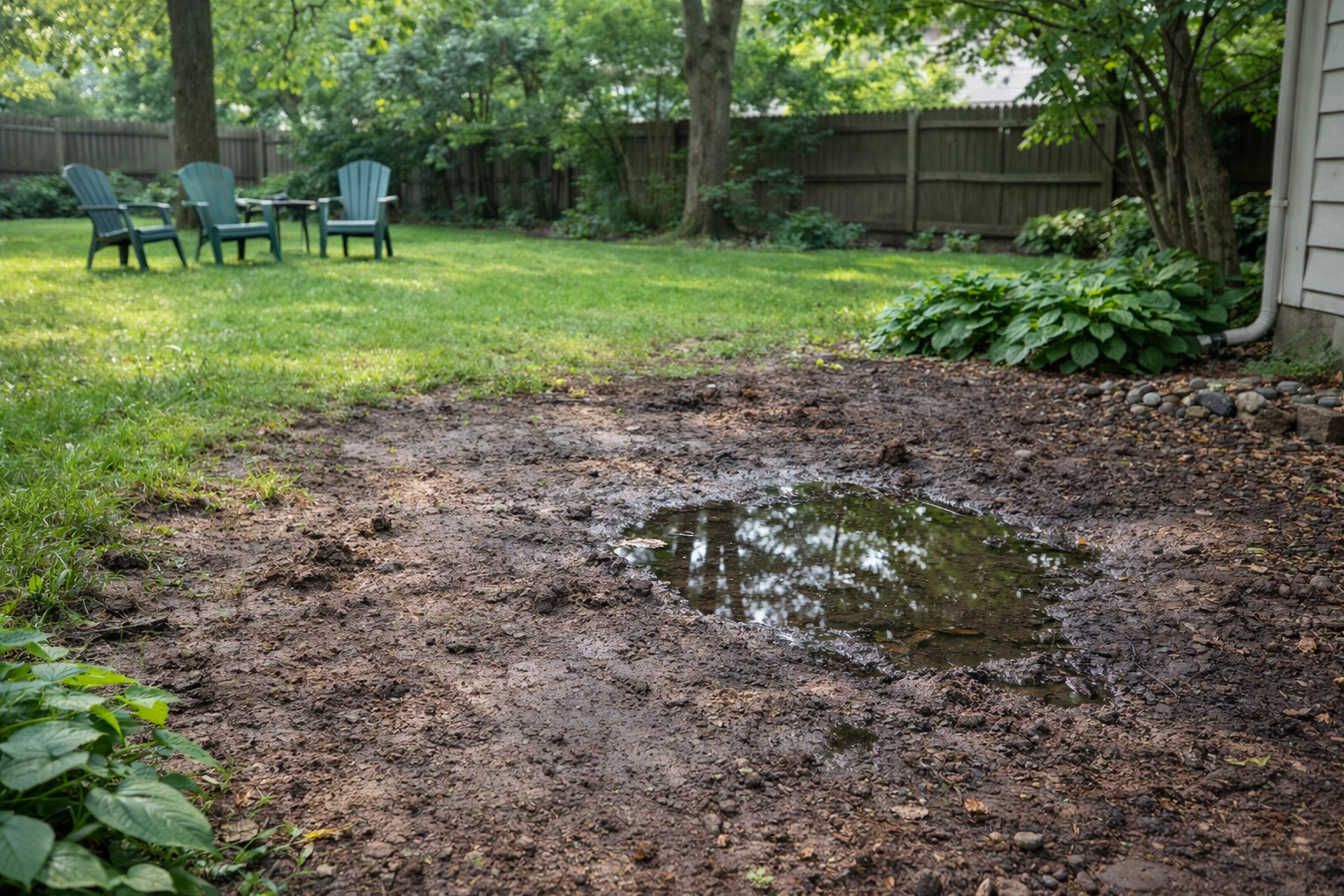
One of the most common reasons bare areas keep failing is excess moisture.
If a section of the lawn stays wet too long after rain, collects runoff, or holds water more easily than the surrounding yard, seed may germinate there and still struggle later. A wet area can limit oxygen movement, weaken root development, and create a slower, less stable environment for the new turf trying to establish.
This is especially common in the greater Rochester area, where spring moisture and recurring rainfall can keep certain parts of a property heavier for longer than homeowners realize.
If the ground stays soft, soggy, or slow to dry, that issue should be part of the conversation before seeding begins. Otherwise the new grass may enter the same difficult conditions that made the area fail before.
A bare patch that stays wet is not just missing grass. It is often showing you that the site needs correction.
Compacted soil can keep new grass from establishing well
Some bare areas are not too wet. They are too tight.
If the soil is compacted, the new grass may have a hard time establishing a healthy root system. Water movement can become less balanced. Early development can be slower. The surface may stay harder and less supportive than the rest of the lawn. In those conditions, seed may sprout, but long term stability becomes harder to build.
This is common in areas that take repeated traffic, near edges, along pathways, around play areas, or anywhere the lawn has been consistently pressed down over time.
Before seeding a bare area, it is worth paying attention to how the ground feels. If the area is firm, worn, or resistant compared to the surrounding lawn, the seed is being asked to succeed in a tighter environment than it should.
That does not mean the area cannot be repaired. It means the soil condition should be part of the fix, not ignored underneath it.
Shade should be evaluated honestly before adding seed
A lot of bare lawn areas sit in sections of the yard that do not get the same light as the rest of the property.
That may be under mature trees, along a fence line, beside the house, or in a narrow side yard that stays shaded for large parts of the day. In those cases, the problem is not just that the grass disappeared. The problem is that the site may not support strong turf performance the same way a sunnier area does.
That is why shade should be looked at honestly before seeding.
If the area is heavily shaded and has already struggled repeatedly, new seed may still face the same limits. It may establish lightly, but staying dense and stable there could remain difficult. This is especially true when shade is paired with tree root competition, moisture imbalance, or restricted airflow.
A shaded bare area needs more than optimism. It needs a realistic evaluation of what that section can support.
Repeated traffic should be considered before repair begins
Some bare areas form because the lawn is being used the same way over and over.
A path across the yard, a route near a gate, the area beside the driveway, or a strip between the patio and another part of the property may take enough repeated pressure that the turf eventually wears out. In those cases, seeding can help restore the area, but it does not change the traffic pattern that caused the damage.
That is why wear matters.
If the same pressure keeps landing in the same place, the repaired area may still struggle to hold. The seed did not fail because it was bad. It failed because the lawn was still being asked to recover in the same high pressure zone without anything else changing.
Before seeding a bare area, it helps to ask whether the problem started with site use rather than just turf loss. That often tells you more than the patch itself.
Tree competition can make bare areas harder to repair than they look
Bare lawn around trees is often more complicated than it first appears.
Even if the area is not fully shaded, it may still be dealing with root competition, reduced moisture availability, uneven light, and a more restrictive growing environment than the rest of the yard. A tree affected area may look like a simple bare patch, but the conditions under and around it are often very different from open turf.
That is why these sections can be frustrating to seed.
The new grass is trying to establish in a location that may already be under steady pressure from the tree itself. If that broader imbalance is not understood, seeding becomes a repeated attempt to force strong turf into a section of the property that may not support it easily.
This does not mean repair is impossible. It means tree related bare areas should not be treated like ordinary open lawn.
Bare spots along concrete often need more than seed and water
Driveway edges, sidewalk strips, and borders near hardscape often break down for a reason.
They deal with more heat, faster moisture loss, tighter growing space, and often more foot traffic than open turf. A bare edge can be reseeded, but if those conditions are still in place, the strip may continue to struggle long after the seed has come up.
That is why concrete edge repair is often temporary when it is approached too simply.
The grass is not just missing. The edge is functioning under more pressure than the rest of the lawn. If that is not part of the evaluation, the new grass may still fall behind once heat and traffic return.
Before seeding bare lawn along concrete, it helps to understand why that edge failed first.
Weed pressure should not be ignored before reseeding
A bare area that is also attracting weeds is telling you something important.
Once turf density is lost, weeds often move into the opening because the area is already underperforming. If the weeds are treated without understanding why the turf disappeared, or if the area is seeded without accounting for the pressure that allowed the weeds in, the repair often feels incomplete.
This matters because the weeds are usually not the whole story.
They are often responding to the same site condition that caused the grass to fail. That may be weak turf density, poor drainage, compaction, shade, or some other recurring imbalance. If the opening is cleaned up but the actual reason for turf loss remains, the area can stay vulnerable even after seeding.
The patch may look better for a while, but it may not become stable.
Timing matters, but timing alone is not enough
A lot of homeowners focus heavily on the timing of seeding, and that does matter.
But even good timing cannot fully overcome a bad site condition. New grass has a better chance when seed goes down during an appropriate window, but that advantage only goes so far if the area still has the same moisture problem, the same compaction issue, the same shade pressure, or the same wear pattern that caused the original bare spot.
That is why timing should not be treated as the whole answer.
It improves the odds, but it does not replace diagnosis. A well timed repair in the wrong conditions can still become a repeated failure.
The best results usually come when timing and site correction work together.
Bare areas often reveal where the lawn is least stable
A bare patch is not just an isolated defect.
It often shows where the property has the least margin for stress. This may be the part of the yard that stays too wet, gets used the hardest, receives the least light, or struggles the most during weather shifts. The opening itself is the symptom. The more useful question is why that section could not hold together when other parts of the property did.
That makes bare spots valuable to read correctly.
They often reveal more about the lawn’s weak points than the better looking sections do. A repair that starts from that understanding is much more likely to hold than one that treats the patch like a random inconvenience.
More seed does not solve a repeated failure pattern
This is one of the biggest mistakes in bare lawn repair.
When a seeded area fails, the first instinct is often to use more seed the next time. But if the site condition that caused the failure is still present, repeating the same approach usually repeats the same outcome. The patch may respond briefly, then open again.
That is why repeated bare spots should be treated as a signal.
They usually mean the area has not actually been corrected yet. The lawn has not just lost grass twice. It has shown the same structural weakness twice.
At that point, adding more seed without a better evaluation is often just extending the cycle.
A successful repair starts with understanding why the turf disappeared
Before seeding a bare lawn area, the right question is not just what grass to use.
It is what caused that part of the lawn to stop holding turf in the first place. Was it moisture. Was it compaction. Was it shade. Was it repeated wear. Was it tree pressure. Was it heat along hardscape. Was it some combination of those things.
That is the real starting point.
Once the cause is understood, the repair has a much better chance of leading to stable grass rather than a temporary fill in. Without that understanding, the lawn is often being asked to perform in conditions that already proved unfavorable.
The patch may look like a simple missing area.
Most of the time, it is not.
Why this matters so much on properties in the Rochester area
Properties around Rochester often deal with variable spring moisture, summer stress, mature trees, compacted traffic areas, and uneven site conditions that make bare spots more complex than they first appear.
A section of lawn may open up because it stayed wet too long in spring, then never recovered well once summer pressure arrived.
Another may thin around a tree line where light and root competition have gradually made stable turf harder to maintain. Another may break down near a driveway where heat and wear keep building.
That is why seeding bare spots in this region often works best when the area is evaluated as part of the larger property, not as a standalone patch.
What homeowners should address before seeding bare lawn areas
Before seeding bare lawn areas, homeowners should address the condition that caused the turf to fail.
That may mean looking at drainage, compaction, shade, repeated traffic, tree competition, edge stress, weed pressure, or some combination of site factors that made the area unstable. Seed can help restore grass, but it works best when the lawn is no longer being asked to grow in the exact same failing conditions.
That is the difference between a repair that fills in and a repair that holds.
LawnLogic FAQ
Should I just add seed to a bare spot in my lawn?
Not always. A bare area often has an underlying cause such as drainage, compaction, shade, or repeated wear. If that issue is still in place, the new grass may struggle again.
Why does grass keep dying in the same bare spot?
Usually because the site condition that caused the original turf loss has not been corrected. The area may still be too wet, too compacted, too shaded, or under too much repeated pressure.
Can I seed bare lawn areas in shady parts of the yard?
Sometimes, but the shaded conditions need to be evaluated realistically first. If the area receives limited light or has tree competition, stable turf may be harder to maintain there.
Does seeding fix bare lawn edges near driveways and sidewalks?
It can help, but those areas often deal with heat, traffic, and drier conditions that make long term success harder if the broader stress is not addressed.
Repair the cause, not just the opening
If bare lawn areas keep coming back, the problem is usually bigger than missing grass. LawnLogic evaluates why turf is failing in specific sections of the property so repairs can be approached with better structure, better timing, and a clearer path toward lasting stability.
Explore More About Managing Your Lawn
Continue building your understanding of how structured lawn care supports long-term stability.